The Spring Ball massacre
Stephen King Three Classic Novels Box Set: Carrie, 'Salem's Lot, the ShiningThe Spring Ball massacre, also known as the Prom Night massacre, The Black Prom, and the pig-blood prank, is the central catastrophe at Ewen Consolidated High School and the immediate beginning of the Chamberlain disaster. What appears at first to be a conventional school celebration becomes a grotesque reversal of a coming-of-age ceremony: Carrie White is publicly elevated as queen beside Tommy Ross, then drenched in pig blood before the applauding school. The humiliation reopens the wound of the shower-room incident, while the ensuing stampede, electrical failures, fire, and blocked escape routes convert a cruel prank into a disaster that kills Tommy Ross and many others and devastates the town beyond the school.
Causes and Ritual Background
The massacre is prepared by a community that has repeatedly treated Carrie White's body as an object of ridicule, discipline, and religious fear. In the shower-room incident, the girls first saw menstrual blood running down her leg, and Susan Snell's disgusted recognition made Carrie’s private bodily change into a public spectacle. The girls’ chanting and laughter established the pattern later repeated at the Spring Ball: blood is exposed, witnesses gather, and collective amusement overwhelms compassion. The event therefore does not begin with the buckets above the stage. Its emotional mechanism has already been rehearsed through social ostracism and bullying.
The school’s response to that earlier humiliation also illustrates the failure of institutional judgment. Rita Desjardin imposed one week of detention, but the punishment was placed in the gym and designed to run the girls ragged because Ewen’s male administration did not seem to understand the severity of what had occurred. The girls were disciplined for conduct, yet Carrie remained the person marked by the incident. A supposedly corrective institution thus preserved the hierarchy in which the group could injure her while she bore the lasting shame.
The Spring Ball itself supplies the language of a formal transition. Vic Mooney, President of the Senior Class, called the students to their seats for the voting for King and Queen. After the votes were counted three times, Vic announced that Tommy and Carrie had won by one vote. The result briefly reverses Carrie’s customary position at the edge of school life. She is no longer merely the girl watched, mocked, or pitied; she is placed at the center, granted a title, and made visible under the ceremonial lights.
The crowning is deliberately theatrical. A performance of "Pomp and Circumstance" accompanies the procession, an aluminum-foil scepter is placed in Tommy Ross’s hand, and a robe with a dog-fur collar is thrown over Carrie’s shoulders. The ushers lead them down the center aisle to the thrones while Miss Geer watches with vindication. The ceremony contains both sincerity and mockery: some applause carries satiric overtones, but it swells into honest, deep, and frightening approval. Carrie is overwhelmed by the speed of events, by trembling legs, and by the feeling that even the comparatively high neck of her gown leaves her exposed. The ceremony offers acceptance, but its unstable mixture of pageantry and derision makes that acceptance vulnerable to reversal.
The Blood-Slicked Coronation
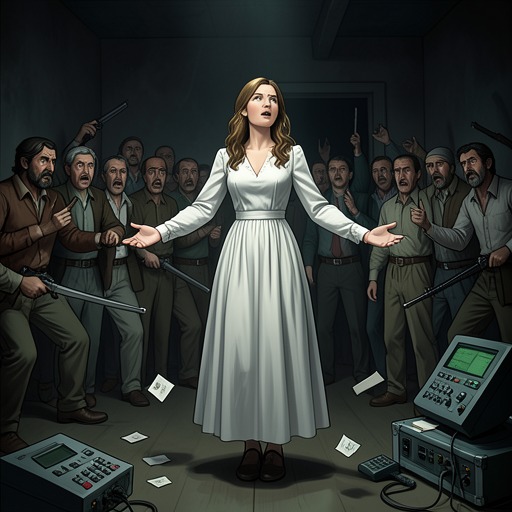
At 10:07, both bands joined in the school song while the audience stood, sang, and applauded. The moment is structured as communal affirmation, with the entire room participating in a single public ritual. From an observer’s later account, however, the celebration is interrupted by a metallic sparkle above the stage apron and then by a huge red splash. Blood strikes the mural and the people onstage; Carrie is drenched most severely, appearing as though she has been dipped in a bucket of red paint, while the band and its white instrument are splattered as well.
The spectators recognize the substance unevenly. Stella Horan initially thinks it is paint, while Norma Watson knows at once that it is blood. Two buckets dangle above the thrones, swinging and banging together, still dripping before they fall. One strikes Tommy Ross on the head with a sound like a gong. The prank is therefore not a single visual insult but a chain of impacts: the crowned pair is contaminated, the stage is marked, the music is disrupted, and the celebratory audience is forced to confront the material reality of the assault.
The crowd’s response is the event’s crucial moral turn. People stop singing, yet the silence does not become aid. Someone laughs, and the laugh is raw, hysterical, and awful rather than amused. Carrie remains seated and stares outward while the laughter grows louder. Students hold their bellies, double over, and point at her; Tommy, badly splashed and slumped in his seat, is the only person not looking at her. Carrie’s face breaks under the pressure. She raises her hands, staggers to her feet, nearly falls, and then hops from the stage as the laughter intensifies.
The blood is not merely a prank prop. It repeats the imagery of Carrie White’s first menstruation, when blood on the shower-room tile exposed her to the girls’ contempt. In Carrie’s perception, the Spring Ball supplies the shower they had wanted to give her: the blood covers her before the whole school, reviving the smell, texture, and terror of the earlier scene. The transformation from menstrual blood to pig blood collapses the distinctions between puberty, pollution, sacrifice, and public punishment. What the school presents as a joke becomes, for Carrie, the final confirmation that the community has converted her body into a spectacle.
From Humiliation to Mass Panic
The first stage of the disaster is psychological, but its consequences become physical almost immediately. After Carrie leaves the stage, the lobby doors slam shut. The sound starts a stampede, and students rush toward exits that will not open even though the doors are never supposed to be locked. Those at the front are battered against them by the crowd behind. Teachers, including Mr. Stephens and Mr. Lublin, try to pull students away by their jackets and skirts, and some people are directed toward the back fire doors. The crowd’s flight is not orderly evacuation; it is a compression of bodies in which fear reproduces the danger.
Then the school sprinkler system activates across the gymnasium. The sudden water initially appears to offer relief or containment, and the panic at the main doors briefly stops as people back away and look toward the ceiling. Yet the water turns the room into a lethal electrical environment. Josie Vreck, trying to deal with the abandoned amplifiers and microphones, grabs a microphone stand and cannot let go. His hair rises, his feet slide across the water, and smoke comes from his shirt before he falls onto an amplifier and catches fire.
The breakdown spreads through the equipment and the building. The main power switches explode backstage, while heavy light cables writhe in the air above the stage. One cable pulls in two and strikes the water with a violet flash. The stage, already transformed by blood, becomes a field of fire, current, and falling machinery. The sequence exposes the disaster as both humanly initiated and systemically amplified: the prank creates the trigger, but vandalized infrastructure, abandoned electrical equipment, and the crowded, water-covered floor magnify it into mass death.
Tommy Ross, already unconscious after the falling bucket strikes him, remains sprawled on the stage as the fire from Josie and the Moonglows’ equipment spreads into the mural and then into the backstage accumulation of old uniforms, books, and papers. He is dead when the oil tank explodes half an hour later. His death gives the ceremony its final reversal. The boy who briefly shared Carrie’s public elevation becomes one of the first confirmed victims, and the pageant’s promise of youthful recognition ends in an image of unconsciousness, fire, and an irretrievable body.
Escape Failure and Institutional Breakdown
The fire is intensified by failures beyond the gymnasium itself. A contemporary Associated Press bulletin reports that the blaze at Ewen Consolidated High School was raging out of control at 10:46 P.M., while the hydrants in the area had been vandalized and city water pressure was inadequate from Spring Street to Grass Plaza. The school’s emergency systems therefore fail in sequence: doors impede the crowd, sprinklers create an electrical hazard, and the damaged water supply deprives firefighters of an effective response. The massacre becomes a disaster of infrastructure as well as intention, demonstrating how a planned humiliation can exploit or expose the vulnerabilities of an entire institution.
The surviving account by Norma Watson emphasizes how quickly ordinary perception collapses. Students first remain rooted in silence, then surge toward exits, pause when the sprinklers activate, and scatter again when the electrical equipment begins to burn. The evacuation routes are unevenly usable: the corridor toward the fire doors is also fitted with sprinklers, though those sprinklers are not operating, and some people escape through open doors while others remain in bewildered groups, staring at the blood being washed from the floor. The scene offers no stable command structure. Teachers try to direct movement, musicians abandon their equipment, and students must decide for themselves whether to run.
The spectacle also produces a grotesque inversion of the school’s ceremony. The school song, applause, crowns, robes, and staged procession have organized the crowd as a single community; blood, locked doors, water, smoke, and electrical flashes then turn that community into a mass of competing bodies. The same collective presence that made Carrie’s humiliation possible now obstructs escape. Public participation changes value from belonging to danger, and the apparent celebration becomes a ritual of expulsion in which the crowned girl leaves the stage while the institution itself begins to consume its audience.
Carrie White and the Repetition of the Shower
For Carrie White, the massacre is experienced as a return rather than an isolated surprise. The first blood she encounters at school is menstrual blood running down her leg in the shower room, where the girls’ laughter and commands make puberty synonymous with exposure. At the Spring Ball, pig blood recreates that scene on a larger and more final scale. She is no longer surrounded by a small circle in the showers but displayed before the whole school, seated beneath the ceremonial lights and drenched in front of the people whose approval has just seemed possible.
The repeated imagery gives the event its internal logic. Carrie’s body, previously condemned as dirty and sinful within Margaret White’s religious worldview, becomes the surface on which the school writes its own cruelty. Margaret White had taught that Eve’s intercourse and childbearing brought the Curse of Blood into the world; she had also treated blood as an object of religious obsession, cutting her own mouth and marking Daddy Ralph’s Bible with it while invoking being washed in the Blood of the Lamb. At the Spring Ball, religious contamination, menstrual shame, and the pig-blood prank converge. The pranksters intend ridicule, but the image carries the force of a sacrifice, with Carrie made both victim and terrible center of the ceremony.
The event’s horror lies partly in the crowd’s inability to recognize the difference between a joke and a catastrophe. The students have learned to read Carrie’s pain through the social language of laughter. When the blood falls, the first laugh supplies permission for others to join; the laughter swells even as Carrie remains motionless and Tommy Ross lies injured beside her. The audience’s reaction does not merely witness the violence. It completes the humiliation, converts it into a communal act, and helps drive the transformation from wounded girl to avenging force.
Expansion into the Chamberlain Disaster
The Spring Ball massacre does not end with the gymnasium fire. After leaving the school, Carrie White turns toward Chamberlain, and the destruction spreads into the town’s electrical network. Power transformers atop light poles bloom with purple light and throw sparks, while high-tension wires fall into the streets in tangled arrangements. Some people touch the cables and collapse into jerky electrical dances; others lie smoldering in the streets as clothing catches fire. The violence therefore travels from the school’s interior systems to public space, making the massacre the immediate opening phase of the broader Chamberlain disaster.
This expansion changes the scale of the event without changing its underlying imagery. In the gymnasium, blood covers the crowned couple, water covers the floor, and electricity turns celebration into death. In Chamberlain, wires spread across the streets and fire passes through the bodies of fleeing residents. What began as the contamination of one girl’s body becomes contamination of the building, the roads, and the town’s inhabitants. The disaster’s physical geography follows the emotional geography of the prank: a private wound made public, then a public order made uninhabitable.
The event also establishes a chain of responsibility that cannot be reduced to a single perpetrator. The pig-blood prank supplies the immediate trigger, but the massacre depends on years of bullying, the school’s inadequate understanding of the shower-room incident, vandalized hydrants, failed escape arrangements, and the crowd’s refusal to respond with compassion. Carrie’s powers make the consequences extraordinary, yet the ordinary social mechanisms that precede them remain visible at every stage. The catastrophe is supernatural in scale but communal in preparation.
Narrative and Thematic Significance
The Spring Ball massacre is structured as a failed rite of passage. Voting and coronation promise Carrie White a temporary entrance into the school’s social order, but the pig blood reveals that the ceremony has not transformed the community’s view of her. It has only placed her more visibly at its center. The pageant’s apparent ascent becomes a fall, and the symbols of inclusion—the robe, scepter, throne, applause, and school song—are reinterpreted as the staging ground for public sacrifice.
Its recurring blood motif binds together the novel’s domestic, religious, educational, and civic worlds. The menstrual blood in the shower room, the blood imagined through Margaret White’s doctrine of sin, the blood placed on the Bible, and the pig blood above the thrones all belong to different immediate contexts, but the event forces them into one system of meaning. Blood marks the body as shameful, turns the victim into an object of collective attention, and finally becomes the visible sign of a social order that can no longer contain its own violence.
The massacre’s ending is consequently larger than the deaths at the dance. Tommy Ross dies beneath the spreading fire, the school burns while emergency systems fail, and the destruction reaches Chamberlain’s streets. The Spring Ball is remembered under several names—The Prom Night massacre, The Black Prom, and the pig-blood prank—but each name captures only part of it: a school celebration, a media-ready horror, or a practical act of cruelty. Taken together, they describe the decisive reversal by which a community’s ritual of belonging becomes the first scene of its devastation.